
Best Homeowners Insurance for Older Homes in 2026 (Top 10 Companies)
The top picks for the best homeowners insurance for older homes are Travelers, USAA, and Allstate, with rates starting at $50 per month. Their competitive rates and tailored coverage make them top choices for older homeowners seeking comprehensive protection and peace of mind for their cherished properties.
Read more Secured with SHA-256 Encryption






Save Money by Comparing Insurance Quotes
Compare Free Home Insurance Quotes Instantly




Table of Contents
Table of Contents

Insurance Content Team Lead
Laura Kuhl holds a Master’s Degree in Professional Writing from the University of North Carolina at Wilmington. Her career began in healthcare and wellness, creating lifestyle content for doctors, dentists, and other healthcare and holistic professionals. In 2018, she started writing for the cannabis industry. She curated news articles and insider interviews with investors and small business ow...
Laura Kuhl

Licensed Insurance Agent
Jeffrey Manola is an experienced life insurance agent who founded TopQuoteLifeInsurance.com and NoMedicalExamQuotes.com. His mission when creating these sites was to provide online consumers searching for life insurance with the most affordable term life insurance, permanent life insurance, no medical exam life insurance, and burial insurance. Not only does he strive to provide consumers with t...
Jeffrey Manola
Updated January 2025
 1,733 reviews
Company Facts
Full Coverage for Older Homes
A.M. Best Rating
Complaint Level
Pros & Cons
1,733 reviews6,589 reviewsCompany Facts
Full Coverage for Older Homes
A.M. Best Rating
Complaint Level
Pros & Cons
6,589 reviews11,638 reviewsCompany Facts
Full Coverage for Older Homes
A.M. Best Rating
Complaint Level
Pros & Cons
11,638 reviewsDiscover the top pick for the best homeowners insurance for older homes, featuring Travelers, USAA, and Allstate with competitive rates starting at $50 per month.

Delve into their tailored coverage options designed specifically for older homes, ensuring comprehensive protection and peace of mind. Explore why these companies stand out as the best choices for homeowners seeking reliable and affordable insurance for their cherished properties.
Our Top 10 Company Picks: Best Homeowners Insurance for Older Homes
| Company | Rank | Multi-Policy Discount | Renovation Discount | Best For | Jump to Pros/Cons |
|---|---|---|---|---|---|
 | #1 | 5% | 23% | Reputation Stability | Travelers |
 | #2 | 10% | 30% | Military Benefits | USAA |
 | #3 | 25% | 10% | Customization Options | Allstate |
 | #4 | 17% | 30% | Personalized Service | State Farm |
 | #5 | 10% | 20% | Home Coverage | Chubb |
 | #6 | 10% | 20% | Comprehensive Coverage | Liberty Mutual |
 | #7 | 20% | 15% | Bundling Discounts | Nationwide |
 | #8 | 10% | 10% | Coverage Options | Farmers |
 | #9 | 20% | 10% | Competitive Rates | American Family |
 | #10 | 10% | 31% | Technology Integration | Progressive |
Finding affordable premiums for home insurance is easy with our free quote comparison tool. Just enter your ZIP code above to find cheap coverage for your home.
- Comprehensive coverage for older homes with Travelers, rates from $50/month
- The Travelers offer competitive rates and comprehensive coverage for older homes
- Travelers stand out as the top pick for reliable and affordable insurance


#4 – State Farm: Best for Personalized Service

Pros
- Personalized Service: State Farm is known for its personalized customer service, offering tailored solutions to meet individual needs.
- Safe Driver Discount: State Farm insurance review & ratings offers a significant 30% discount for safe drivers, promoting responsible driving habits.
- Extensive Agent Network: With a vast network of agents, State Farm offers accessibility and convenience for its customers.
Cons
- Higher Premiums: While offering personalized service, State Farm’s premiums may be relatively higher for some customers.
- Limited Coverage Options: State Farm may not offer as diverse coverage options compared to some competitors.
Free Home Insurance Comparison
Compare Quotes From Top Companies and Save
Secured with SHA-256 Encryption
#5 – Chubb: Best for Home Coverage

Pros
- Home Coverage Expertise: Chubb specializes in home coverage, offering tailored solutions to protect customers’ properties.
- Safe Driver Discount: Chubb Insurance review & ratings offers a 20% discount for safe drivers, incentivizing responsible behavior.
- Strong Financial Standing: Chubb maintains a strong financial standing, ensuring stability and reliability.
Cons
- Limited Discount Options: Offers fewer discount options compared to some competitors.
- Premium Pricing: While providing quality coverage, Chubb’s premiums might be relatively higher for some customers.
#6 – Liberty Mutual: Best for Comprehensive Coverage

Pros
- Comprehensive Coverage: Liberty Mutual offers comprehensive coverage options to protect against various risks and liabilities.
- Accessibility: Liberty Mutual offers easy accessibility through its user-friendly online platforms and mobile app.
- Strong Financial Stability: Liberty Mutual maintains strong financial stability, ensuring reliability and security for its customers.
Cons
- Limited Discount Options: Offers fewer discount options compared to some competitors.
- Customer Service: Some customers may experience challenges with customer service responsiveness and efficiency.


#10 – Progressive: Best for Technology Integration

Pros
- Technology Integration: Progressive leads the industry with a strong focus on technology integration, offering innovative tools and platforms for a seamless customer experience.
- Customization Options: Progressive provides a variety of customizable policy options, allowing customers to tailor their coverage to their specific needs.
- Claims Process: Progressive insurance review & ratings offers a streamlined and efficient claims process, utilizing technology to expedite claims and improve customer satisfaction.
Cons
- Premium Pricing: Progressive’s premiums may be relatively higher for some customers compared to other insurers.
- Limited Personalized Service: Despite its technological advancements, some customers may prefer more personalized service, which could be lacking with Progressive’s online-centric approach.
Free Home Insurance Comparison
Compare Quotes From Top Companies and Save
Secured with SHA-256 Encryption
Challenges of Insuring Older Homes
Many people love the unique architectural details of older homes, such as stained glass windows and wide hardwood floorboards. These homes were built with high-quality materials and craftsmanship, making them desirable and durable. However, these same features can make it difficult to find insurance.
Jeff Root Licensed Life Insurance Agent
Some companies refuse to insure homes over 100 years old or limit coverage for those built . Insurance policies aim to cover the cost of rebuilding a home in the event of a total loss. For older homes, this replacement cost is often higher due to the expensive materials and craftsmanship required. As a result, insurance providers consider older homes a riskier investment.
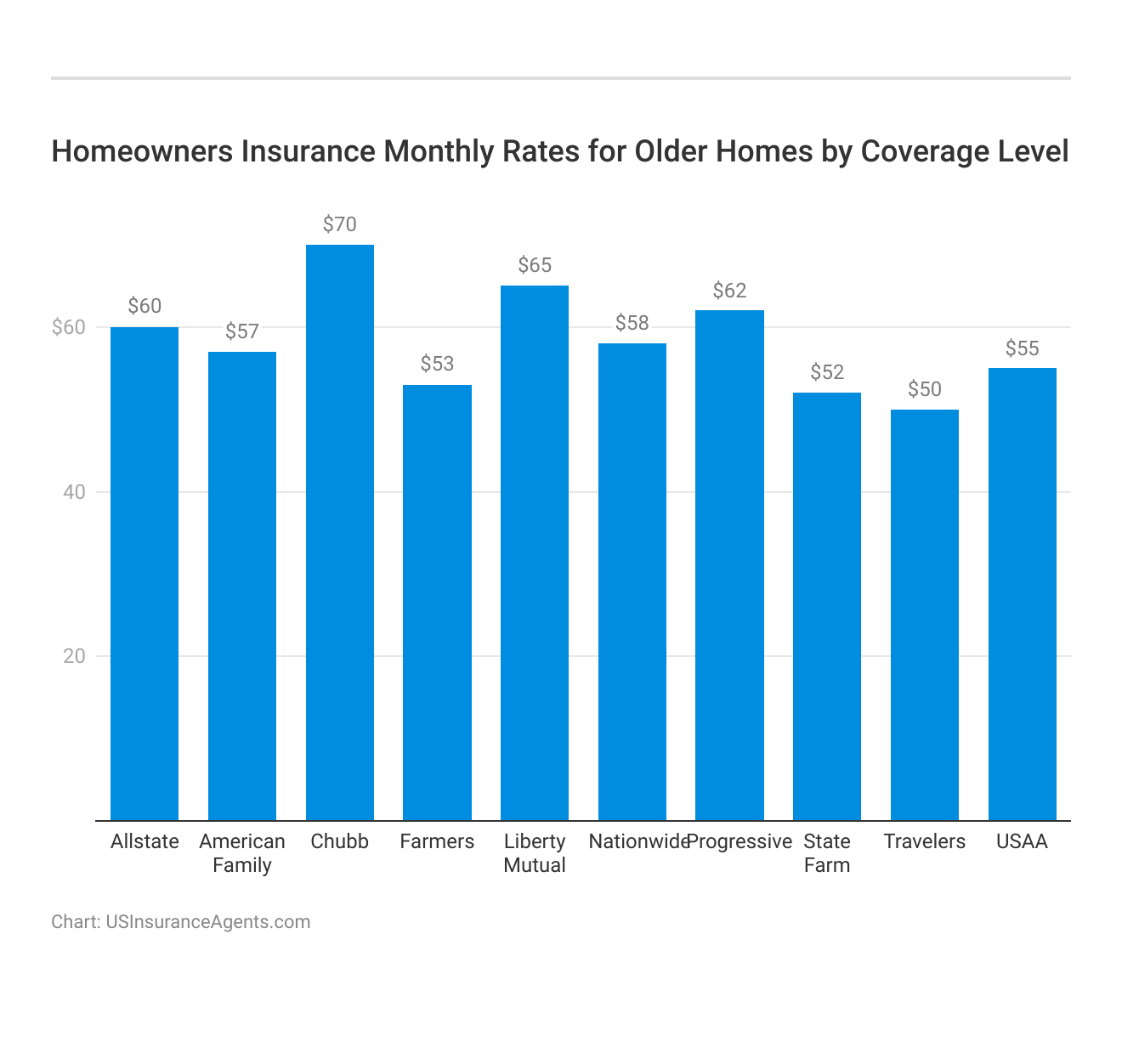
Homeowners Insurance Monthly Rates for Older Homes by Coverage Level & Provider
Insurance Company Minimum Coverage Full Coverage
Allstate $60 $120
American Family $57 $114
Chubb $70 $140
Farmers $53 $106
Liberty Mutual $65 $130
Nationwide $58 $116
Progressive $62 $124
State Farm $52 $104
Travelers $50 $100
USAA $55 $110
The monthly rates for homeowners insurance for older homes vary by provider and coverage level. For minimum coverage, State Farm offers the lowest rate at $52, while Chubb has the highest at $70. Check out our ranking of the top providers: Best Homeowners Insurance for Older Homes
For full coverage, Travelers is the most affordable at $100, with Chubb again being the highest at $140. Other providers, such as Allstate, American Family, Farmers, Liberty Mutual, Nationwide, Progressive, and USAA, offer rates that fall between these ranges.
This chart compares monthly homeowners insurance rates for older homes across different insurance providers, segmented by minimum and full coverage levels. The rates vary among major insurers, with minimum coverage starting around $20 and full coverage ranging from $50 to $70.
Notable providers include Allstate, American Family, Chubb, Farmers, Liberty Mutual, Nationwide, Progressive, State Farm, Travelers, and USAA.
The Hidden Costs of Historic Home Renovations
Renovating homes over 25 years old is costly and challenging, especially with elements like stained glass needing skilled artisans. Brian So of Brian So Insurance states these homes often require updates to roofs, electrical, plumbing, and heating systems. To gain further insights, consult our comprehensive guide titled “Does home insurance cover plumbing?”
Asphalt roofs last 25 years, concrete tiles 50. Homes from 1900-1945 can still get traditional insurance with add-ons. Historic homes typically need modern updates, including new electrical systems and central HVAC units, to reduce repair costs and improve insurance coverage. Renovations on historic homes generally cost 5.6 percent more than similar-sized newer homes.
Home Renovation Costs by Home Type and Square Footage
| Home Type | Cost per Square Foot |
|---|---|
| Apartment | $25–$40 |
| Condo | $75–$100 |
| Farmhouse | $10–$50 |
| Row House | $25–$75 |
| Townhouse | $10–$35 |
| Victorian | $20–$200 |
Homes built before 1900 often need costly, unique materials for repairs, including thicker hardwood planks and lath and plaster walls. Even small fixtures are more expensive to replace. A new roof on a modern home costs $1,500–$8,000, but historic materials can raise this to $12,000.
Drywall costs about $4,800, and plaster $6,000. Renovating a historic home of 4,000–7,000 square feet can range from $300,000 to $1.75 million. To ensure full coverage, consult your insurance agent, verify your maximum replacement cost coverage, and contact a specialized insurance appraisal company. This will help match your home’s worth to your policy coverage.
Historic vs. Old Homes: Understanding the Difference
Historic designation refers to homes built around the turn of the 20th century, while “older homes” typically means those built before World War II. Historic homes often have unique features requiring period-specific materials and may be registered as historic landmarks, necessitating adherence to historic preservation guidelines for repairs.
Homes with historic designations must be rebuilt to original specifications. Nearly half of U.S. homes were built before 1970, limiting options for new homeowners. U.S. Census Bureau data highlights the median age of homes. For additional details, explore our comprehensive resource titled “Homeowners Insurance: A Complete Guide.”
Housing Stock by Area & Year Built
| Year Built | Total | New England | Middle Atlantic | East North Central | West North Central | South Atlantic | East South Central | West South Central | Mountain Division | Pacific Division |
|---|---|---|---|---|---|---|---|---|---|---|
| 2016 to 2017 | 841,000 | 45,000 | 58,000 | 75,000 | 55,000 | 162,000 | 55,000 | 175,000 | 120,000 | 121,000 |
| 2010 to 2015 | 5,113,000 | 113,000 | 419,000 | 497,000 | 347,000 | 1,182,000 | 345,000 | 1,103,000 | 516,000 | 589,000 |
| 2005 to 2009 | 7,936,000 | 214,000 | 575,000 | 796,000 | 554,000 | 2,070,000 | 516,000 | 1,322,000 | 810,000 | 1,080,000 |
| 2000 to 2004 | 9,448,000 | 244,000 | 626,000 | 1,275,000 | 559,000 | 2,389,000 | 682,000 | 1,424,000 | 1,053,000 | 1,195,000 |
| 1995 to 1999 | 9,132,000 | 226,000 | 560,000 | 1,320,000 | 703,000 | 2,387,000 | 645,000 | 1,290,000 | 889,000 | 1,111,000 |
| 1990 to 1994 | 6,564,000 | 204,000 | 595,000 | 1,067,000 | 440,000 | 1,510,000 | 527,000 | 596,000 | 604,000 | 1,023,000 |
| 1985 to 1989 | 8,952,000 | 353,000 | 766,000 | 1,039,000 | 509,000 | 2,435,000 | 548,000 | 1,076,000 | 766,000 | 1,459,000 |
| 1980 to 1984 | 7,736,000 | 337,000 | 579,000 | 838,000 | 473,000 | 1,720,000 | 489,000 | 1,312,000 | 670,000 | 1,319,000 |
| 1970 to 1979 | 17,953,000 | 745,000 | 1,641,000 | 2,614,000 | 1,288,000 | 3,536,000 | 1,285,000 | 2,193,000 | 1,534,000 | 3,117,000 |
| 1960 to 1969 | 12,685,000 | 649,000 | 1,758,000 | 2,022,000 | 891,000 | 2,359,000 | 793,000 | 1,372,000 | 762,000 | 2,078,000 |
| 1950 to 1959 | 12,818,000 | 662,000 | 2,288,000 | 2,388,000 | 937,000 | 2,028,000 | 673,000 | 1,108,000 | 482,000 | 2,250,000 |
| 1940 to 1949 | 5,740,000 | 296,000 | 1,050,000 | 1,097,000 | 297,000 | 871,000 | 310,000 | 523,000 | 224,000 | 1,073,000 |
| 1930 to 1939 | 3,620,000 | 264,000 | 895,000 | 716,000 | 238,000 | 442,000 | 208,000 | 231,000 | 139,000 | 487,000 |
| 1920 to 1929 | 4,682,000 | 361,000 | 1,466,000 | 956,000 | 340,000 | 408,000 | 145,000 | 160,000 | 126,000 | 721,000 |
| 1919 or earlier | 8,340,000 | 1,119,000 | 2,744,000 | 1,822,000 | 895,000 | 475,000 | 196,000 | 185,000 | 222,000 | 682,000 |
Median Age of Housing Stock by State
| States | Median Age of Housing Stock |
|---|---|
| Alabama | 29–34 Years |
| Alaska | 29–34 Years |
| Arizona | 21–28 Years |
| Arkansas | 29–34 Years |
| California | 40–47 Years |
| Colorado | 29–34 Years |
| Connecticut | 48–57 Years |
| Delaware | 29–34 Years |
| Florida | 29–34 Years |
| Georgia | 21–28 Years |
| Idaho | 21–28 Years |
| Illinois | 40–47 Years |
| Indiana | 40–47 Years |
| Iowa | 48–57 Years |
| Kansas | 40–47 Years |
| Kentucky | 29–34 Years |
| Louisiana | 35–39 Years |
| Maine | 35–39 Years |
| Maryland | 35–39 Years |
| Massachusetts | 48–57 Years |
| Michigan | 40–47 Years |
| Minnesota | 35–39 Years |
| Mississippi | 29–34 Years |
| Missouri | 35–39 Years |
| Montana | 35–39 Years |
| Nebraska | 40–47 Years |
| Nevada | 21–28 Years |
| New Hampshire | 35–39 Years |
| New Jersey | 48–57 Years |
| New Mexico | 29–34 Years |
| New York | 48–57 Years |
| North Carolina | 21–28 Years |
| North Dakota | 40–47 Years |
| Ohio | 40–47 Years |
| Oklahoma | 35–39 Years |
| Oregon | 35–39 Years |
| Pennsylvania | 48–57 Years |
| Rhode Island | 48–57 Years |
| South Carolina | 21–28 Years |
| South Dakota | 35–39 Years |
| Tennessee | 29–34 Years |
| Texas | 21–28 Years |
| Utah | 21–28 Years |
| Vermont | 35–39 Years |
| Virginia | 29–34 Years |
| Washington | 29–34 Years |
| Washington, D.C. | 30-35 Years |
| West Virginia | 40–47 Years |
| Wisconsin | 40–47 Years |
| Wyoming | 35–39 Years |
In the Northeast, homes are older, particularly in New York, Massachusetts, and Rhode Island, averaging from 53 to 57 years. Conversely, the South has newer homes, with some states below the national average of 37 years.
Nevada, Georgia, and Arizona have younger owner-occupied homes, averaging around 21 to 25 years old. However, if you do not have the good fortune of living in the Southeastern region of the U.S., insuring an older home will become more and more of a problem for you as a homeowner.
Free Home Insurance Comparison
Compare Quotes From Top Companies and Save
Secured with SHA-256 Encryption
Coverage Options For Older Homes
Due to the high cost of replacement, many insurance companies simply won’t offer coverage for this type of home. Those who do often require the homeowner to pay significantly higher premiums. For instance, a policy on a newer home usually costs around $500, but a policy for a home that’s 100 years old or more could easily come with a premium that’s $1,000–$3,000.
If you’re thinking about purchasing an older home, it’s a good idea to put some feelers out about the cost of insurance before you put in an offer. Farmers Insurance, Chubb, Fireman’s Fund, and a few other insurance companies specialize in this type of insurance.
However, a typical insurance policy may be suitable for an older farmhouse home or if historically accurate renovations aren’t a concern. In general, it doesn’t hurt to shop around. A local independent insurance broker may be best suited to helping you find a policy that matches your unique needs.
Insurance for Homes With Historic Designations
Justin Wright Licensed Insurance Agent
If you cherish your older home, consult an insurance agent who specializes in such properties. They can identify the unique materials used and tailor a policy accordingly. Many insurers unfamiliar with historic homes may decline coverage. Explore our list of the leading providers: Best Home Insurance for Renovations
Costly repairs on older homes, such as replacing century-old floorboards with original materials, tend to be long-lasting, potentially enduring another 100 years. These high-quality materials can also increase your home’s value if you decide to sell. An older home is best viewed as a long-term investment.
Tips for Avoiding Insurance Mistakes With Historic & Older Homes
Insuring historic and older homes can be a complex process due to the unique challenges these properties present. From balancing the charm of historic features with the financial realities of insurance to navigating the intricacies of coverage gaps, homeowners need to be well-prepared.
- Finding the Right Policy: The process of insuring a home involves selecting an appropriate insurance policy. While older homes present more difficulties than newer ones, obtaining insurance is achievable.
- Balancing Historic Features: Homeowners need to manage their appreciation for historic characteristics alongside the financial aspects of insurance.
- Seek Assistance From Trustworthy Brokers: Many insurance policies for older homes have significant gaps, which can result in homeowners having to pay out-of-pocket expenses. NTIS works to prevent this by ensuring comprehensive coverage from the start.
- Obtain Accurate Home Cost Appraisal: Use services like Historic Appraisal Services, LLC to determine the replacement cost of your home. This information helps in selecting a full coverage policy that suits your needs.
- Stay Informed and Responsible: Protect your home and family by staying informed about your insurance coverage and maintaining timely mortgage payments.
- Understand Provider Responsibilities: Your insurance provider’s role is to cover costs as outlined in your policy. They are not responsible for informing you about coverage gaps. Claims on uncovered incidents will not be negotiable.
- Avoid Uninformed Excuses: Ensure you are fully aware of your insurance coverage to avoid situations where you might have to claim ignorance about policy details.
- Consider Living in Historic Homes: Whether or not you choose to live in an old home, it’s essential to be well-informed about the insurance specifics for such properties.
- Utilize Online Quote Options: For a detailed quote on insuring an older or historic home, use the free online quote option by entering your ZIP code. This tool helps in understanding potential insurance costs and navigating the process easily.
Protecting a historic or older home requires careful consideration and informed decision-making. By following these tips, you can ensure that your beloved property is covered adequately and avoid common pitfalls. To learn more, explore our comprehensive resource on insurance titled “Home and Car Insurance Discounts.”

Whether you already own an older home or are considering purchasing one, being proactive about insurance will give you peace of mind and safeguard your investment. For a comprehensive understanding of potential costs, don’t hesitate to use online quote options and consult with trusted insurance brokers.
Free Home Insurance Comparison
Compare Quotes From Top Companies and Save
Secured with SHA-256 Encryption
The Impact of the National Historic Preservation Act on Insurance
The National Historic Preservation Act of 1966, which established the National Register and National Historic Landmarks managed by the National Park Service, imposes strict repair rules on historic homes but offers tax incentives. While historic renovations are more costly and time-consuming, they can ultimately increase home value and are ideal for long-term investment.
Dani Best Licensed Insurance Producer
Homes with National Register or Landmark status can benefit from tax breaks, such as the historic preservation easement tax deduction and a 20 percent rehabilitation tax credit for business-operating properties. Additionally, repairs in historic neighborhoods often require local historic society approval. To delve deeper, refer to our in-depth report titled “What is Tax filing requirement?”
To save on insurance for older homes, ensure the property is up to code, modernize essential systems like wiring and plumbing, and consider increasing deductibles or taking out separate riders for unique historic features.
Case Studies: Best Homeowners Insurance for Older Homes
Older properties often come with distinctive architectural features, historical significance, and potential challenges such as outdated systems and materials. Each scenario highlights how specialized coverage options can protect and preserve the historical and architectural integrity of these cherished properties.
- Case Study #1 – The Johnson Family’s Heritage Home: The Johnson family’s 1920s colonial house in Massachusetts requires specialized insurance due to its unique architecture and age. After researching, they chose Travelers for tailored coverage and competitive rates.
- Case Study #2 – The Smiths’ Victorian Treasure: The Smiths own a Victorian-style home built in 1895 in San Francisco, choosing State Farm for its expertise with historic properties and outstanding service.
- Case Study #3 – The O’Neills Farmhouse in Rural Ohio: The O’Neills live in a farmhouse dating back to 1903 in rural Ohio, opting for American Family Insurance for its flexible coverage and strong rural reputation.
- Case study #4 – The Garcia’s Craftsman Bungalow in Portland: The Garcia Family resides in a charming 1915 Craftsman Bungalow in Portland, Oregon, appreciated for its unique handcrafted details and vintage fixtures, insured by Nationwide for its comprehensive coverage and historical preservation focus.
Each case study exemplifies the importance of choosing insurance that not only protects against standard risks but also recognizes and preserves the historical and architectural integrity of older homes.
Michelle Robbins Licensed Insurance Agent
Whether it’s a colonial house in Massachusetts, a Victorian treasure in San Francisco, a farmhouse in rural Ohio, or a Craftsman bungalow in Portland, these stories underscore the value of specialized homeowners insurance in safeguarding our architectural heritage for generations to come.
The Bottom Line: Top Homeowners Insurance for Older Homes
Finding the right homeowners insurance for older homes can be challenging due to unique features and higher repair costs. Top picks include Travelers, USAA, and Allstate, offering tailored coverage and competitive rates. Key strategies for saving on premiums include modernizing systems, shopping around, and considering higher deductibles.
Homes with historical designations may benefit from tax incentives but often require period-specific repairs. By comparing quotes and consulting with specialized agents, homeowners can ensure comprehensive protection for their older properties. For a thorough understanding, refer to our detailed analysis titled “Your Insurance Agent’s Role in the Claims Process.”
Protecting your home doesn’t have to be expensive. Enter your ZIP code below into our free tool to find affordable homeowners insurance today.
Frequently Asked Questions
Why are older homes harder to insure?
Older homes are harder to insure because the cost of repairing period details or replacing outdated electrical and plumbing systems can drive up the cost of homeowners insurance. Insurance policies are designed to cover the amount that it would cost to rebuild the home from the ground up in the event of a total loss, and in many cases, the replacement cost of these details in older homes is much higher than in newer homes.
What are some coverage options for older homes?
Due to the high cost of replacement, many insurance companies simply won’t offer coverage for older or historic homes. Those who do often require the homeowner to pay significantly higher premiums. It’s best to shop around, and a local independent insurance broker may be best suited to helping you find a policy that matches your unique needs.
Make sure to compare home insurance rates by entering your ZIP code below to avoid overpaying.
What are the hidden costs of repairing older homes?
The cost of repairing older homes can be much higher than repairing newer homes due to the time and skill involved in recreating period details. For example, replacing the windows on a newer home is often easier and cheaper than replacing intricate stained glass windows in an older home.
To expand your knowledge, refer to our comprehensive handbook titled “Tips for How to Get Cheap Home Insurance.”
How can you save money on insurance for an older home?
Standard homeowners policies will generally only cover the full amount of an older or historic home if your premiums are drastically higher than usual. However, there are still a handful of ways you can reduce your monthly rates, such as installing security and safety features, bundling your insurance policies, and increasing your deductible.
How do insurers evaluate the repair costs of an insured’s damaged building?
Insurers evaluate repair costs by considering factors such as the extent of the damage, current market prices for materials and labor, and the specific details of the building, including its size, age, and construction type. They may also refer to standard pricing guides and industry benchmarks.
What are some common methods insurers use to estimate the repair costs of damaged buildings?
Insurers commonly use two methods to estimate repair costs for damaged buildings: professional appraisers and software programs. Professional appraisers conduct on-site inspections to provide detailed and accurate cost assessments, while software programs use data and algorithms to estimate costs based on pre-determined criteria.
To gain profound insights, consult our extensive guide titled “Commercial General Liability (CGL) Insurance: A Complete Guide.”
Why might an insurer use a professional appraiser for damage assessment?
Insurers use professional appraisers for damage assessment to ensure accuracy and reliability. Professional appraisers bring expertise and experience, providing thorough inspections and detailed reports that reflect the true cost of repairs, which helps in fair settlement of claims.
What role do software programs play in estimating repair costs for damaged buildings?
Software programs play a role in estimating repair costs by utilizing databases of cost information, standardized calculation methods, and historical data. These programs can quickly generate cost estimates based on the input details about the damage, offering a streamlined and efficient approach to initial cost estimation.
How can you find affordable insurance for an older or historic home?
Shopping around, getting a historically accurate home appraisal, and raising your premiums are just a few of the ways that you can find affordable insurance for your older or historic home. It may also be necessary to find a provider through a trusted broker that specializes in insuring older and historic homes.
For a comprehensive overview, explore our detailed resource titled “How much do insurance brokers make?”
How do market prices influence the estimation of repair costs?
Market prices influence the estimation of repair costs by reflecting the current costs of materials, labor, and other resources needed for repairs. Insurers must stay updated with market fluctuations to provide accurate cost estimates and ensure that settlements cover the actual expenses involved in the repairs.
Explore home insurance costs in your area by entering your ZIP code into our free comparison tool below.
Get a FREE Quote in Minutes
Insurance rates change constantly — we help you stay ahead by making it easy to compare top options and save.
Secured with SHA-256 Encryption